


.png)
When someone asks an AI "what's the best CRM for a small agency," the answer is built from sources. YouTube is the biggest one. We pulled the data from four independent studies to show which AI products lean on video, which video formats actually get cited, and how to structure your channel so AI can read it.
Your buyers have changed how they research software. Instead of opening ten tabs and reading G2 reviews for an hour, a growing share of them now asks an AI: "What's the best project management tool for a remote team of 20?" and gets a single, summarized answer with a handful of cited sources.
Whoever is in those sources wins the consideration stage. Everyone else is invisible.
So the obvious question for any B2B software marketer is: where do AI answers come from?
The short answer, backed by every major citation study published in the last year: YouTube is the single most-cited domain in Google's AI answers, and it punches far above its weight in Perplexity too.
Here's what the data says, and what to do about it.
TL;DR
- YouTube is the #1 most-cited domain in Google AI Overviews, with a 20.9% mention share across 3M+ US queries (Ahrefs, June 2026). That's ahead of Wikipedia, Amazon, and every news site.
- 29.5% of all Google AI Overviews cite at least one YouTube video (BrightEdge). In Google AI Mode it's 16.6%, in Perplexity 9.7%.
- AI doesn't cite videos because they're popular. 40.8% of cited videos have fewer than 1,000 views (OtterlyAI). It cites them because they're structured and answer the question.
- 94% of cited videos are long-form, not Shorts. The sweet spot is 10-20 minutes.
- The most-cited content types map almost perfectly to software buying: tutorials, product demos, comparisons, reviews, and pricing content (BrightEdge).
If you sell software and you're not producing structured YouTube content, you're handing the AI answer box to whoever is.
The AI products that lean on video the most
Not every AI assistant treats YouTube the same way. This matters for where you focus, so let's look at it platform by platform.
Google AI Overviews: YouTube is the #1 source, period
Ahrefs' Brand Radar tracked every domain cited by Google AI Overviews across more than 3 million US queries. YouTube came out on top with a 20.9% mention share, and it actually appears twice in their top 50 as two separate site properties, with a combined share of roughly 40%.
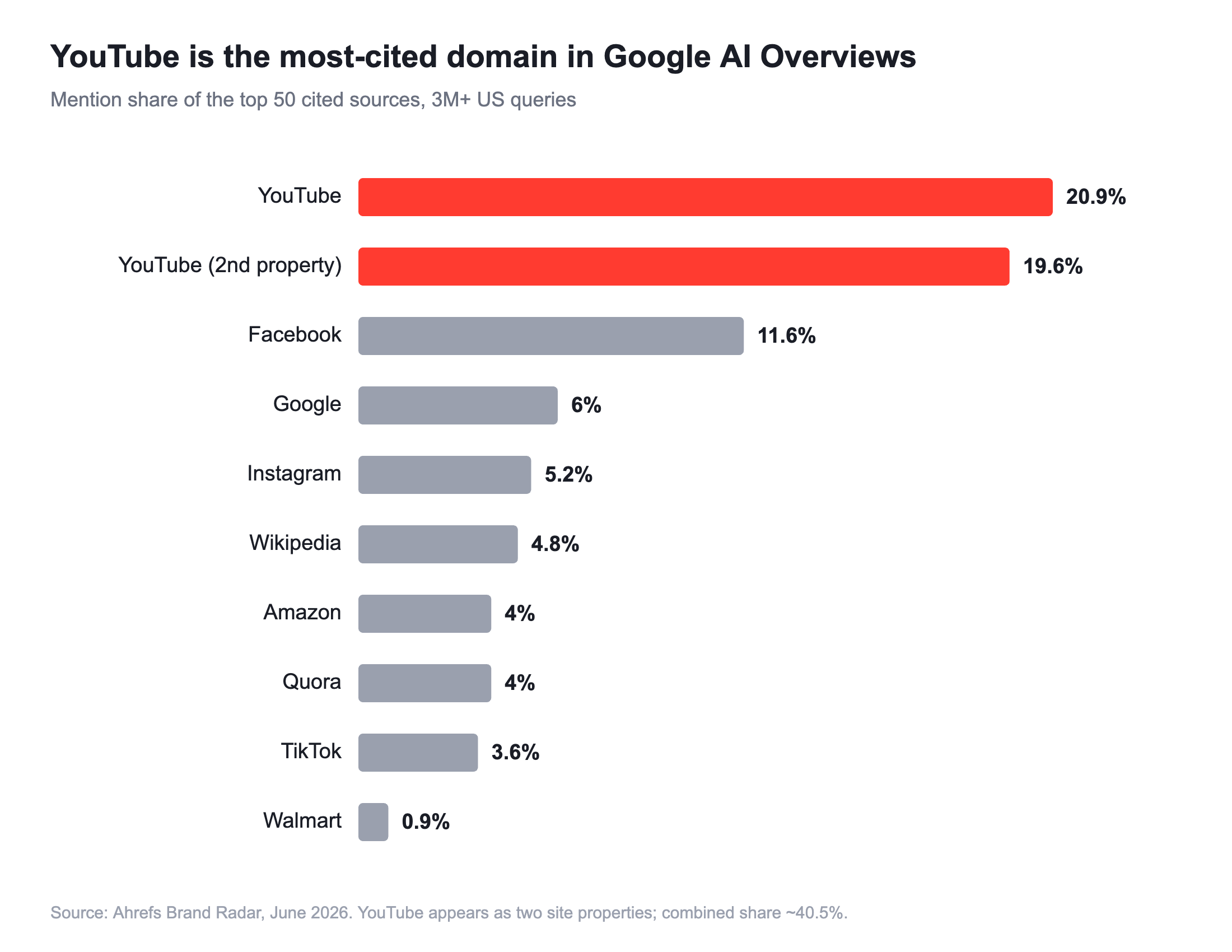
For context: AI Overviews reach over 2 billion monthly users. There is no AI surface with more reach, and its favorite source is a video platform.
BrightEdge's independent analysis confirms the same pattern from a different angle: 29.5% of AI Overviews cite YouTube, making it the top domain ahead of Mayo Clinic (12.5%). When Google builds an AI answer, video is not a nice-to-have source. It's the default one.
Google AI Mode and Perplexity: heavy video users
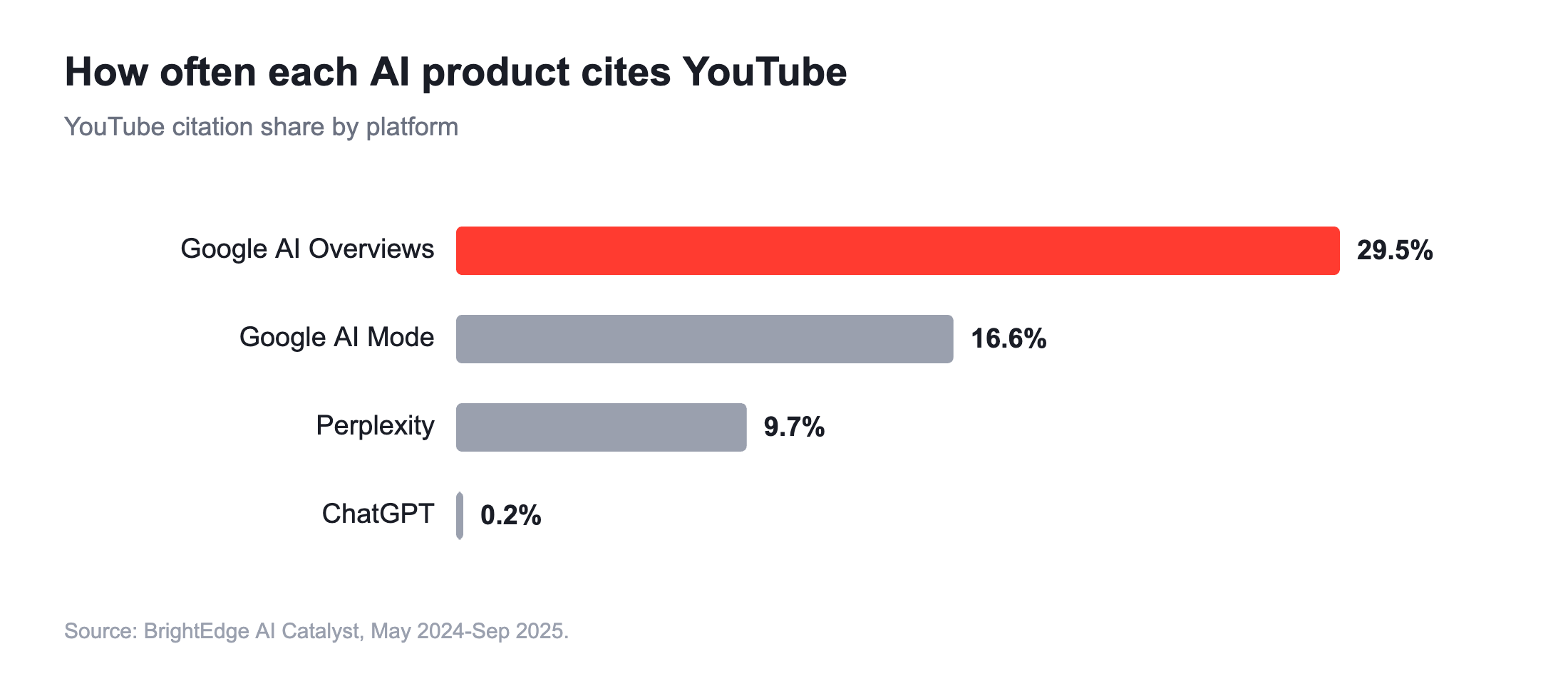
Google AI Mode, the full conversational search experience, cites YouTube in 16.6% of responses, where it's also the #1 domain (BrightEdge).
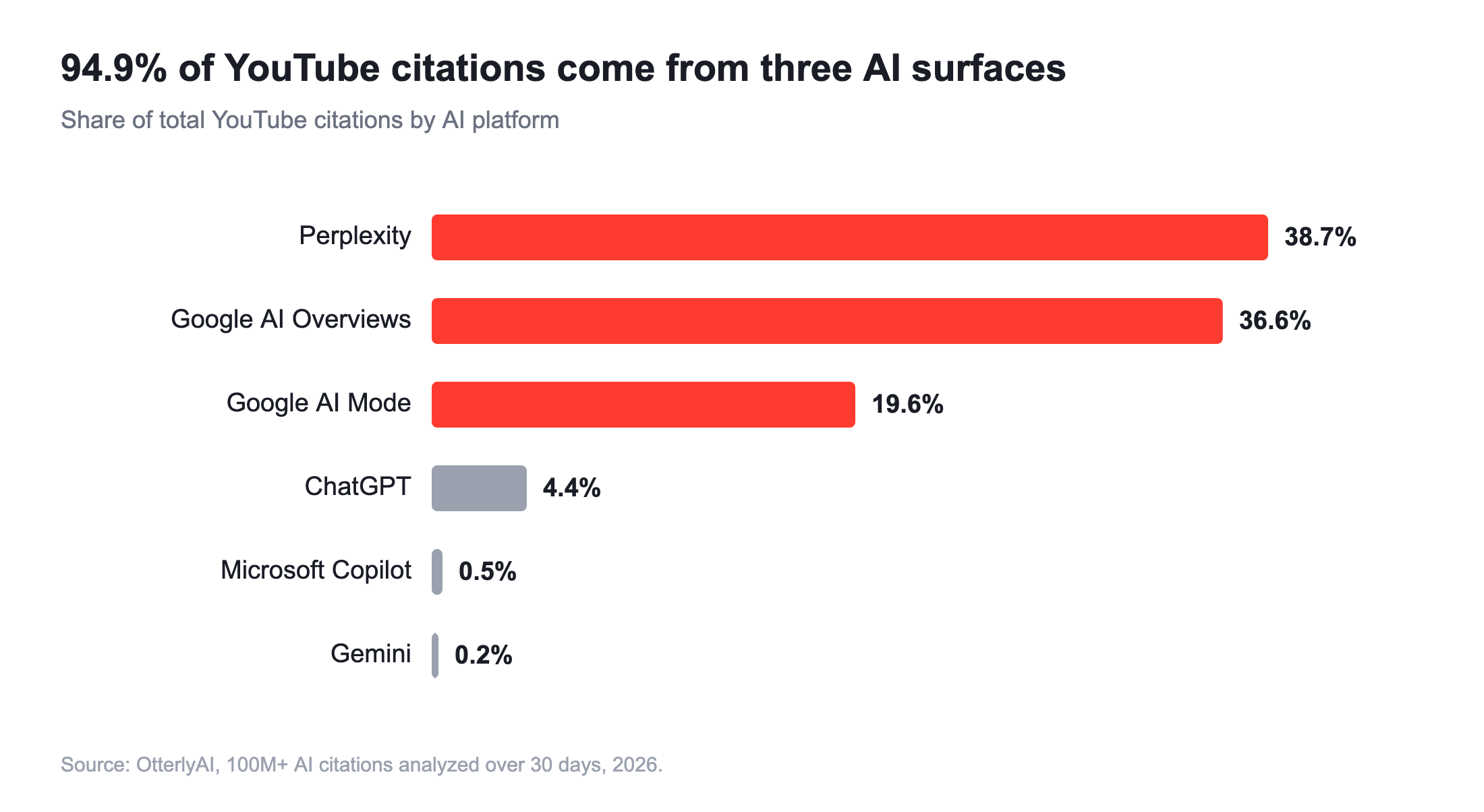
Perplexity is the surprise. OtterlyAI analyzed 100M+ AI citations and found that Perplexity alone drives 38.7% of all YouTube citations across AI platforms, slightly more than AI Overviews (36.6%). For a tool with no business reason to favor a Google property, that says a lot about how useful structured video is as a source.
ChatGPT, Gemini, Copilot: text-first (for now)
Honesty matters here. ChatGPT cites YouTube in only about 0.2% of responses, and Gemini and Copilot barely cite it at all. These platforms build answers from text: articles, documentation, review sites, Reddit.
Two things worth knowing though:
- ChatGPT's YouTube citations grew 100% week over week in BrightEdge's data, off a small base, so the direction of travel is clear.
- The fix for text-first platforms is simple: publish a text companion (a structured article or transcript-based post) alongside every video. One production, two citation surfaces. More on that below.
So the realistic picture is this: a citation-optimized YouTube channel gets you into Google AI Overviews, Google AI Mode, and Perplexity, which together account for 94.9% of all YouTube citations in AI search. That's where the volume is anyway.
Why this matters more for software and B2B than for anyone else
Here's the part most coverage of these studies misses: the query categories where AI cites YouTube most are exactly the queries software buyers ask.
BrightEdge broke down where YouTube citations actually show up:
- Tutorials, with software how-to content called out explicitly
- Product demos and walkthroughs
- Reviews and comparisons
- Pricing and deal-hunting queries
And where YouTube is least likely to be cited: abstract concepts, career advice, strategy content, and pure informational queries.
In other words, AI leans on video hardest at the exact moment a buyer is evaluating products. "How does X handle SSO," "X vs Y for agencies," "is X worth it at $99/month." That's bottom-of-funnel, high-intent territory, and the source AI reaches for is a well-structured video.
There's a second reason B2B software is uniquely positioned to win here. OtterlyAI's social citation data shows that within social sources, only two platforms really matter: Reddit (46.4%) and YouTube (31.8%). Together they're 78.2% of all social citations in AI search.
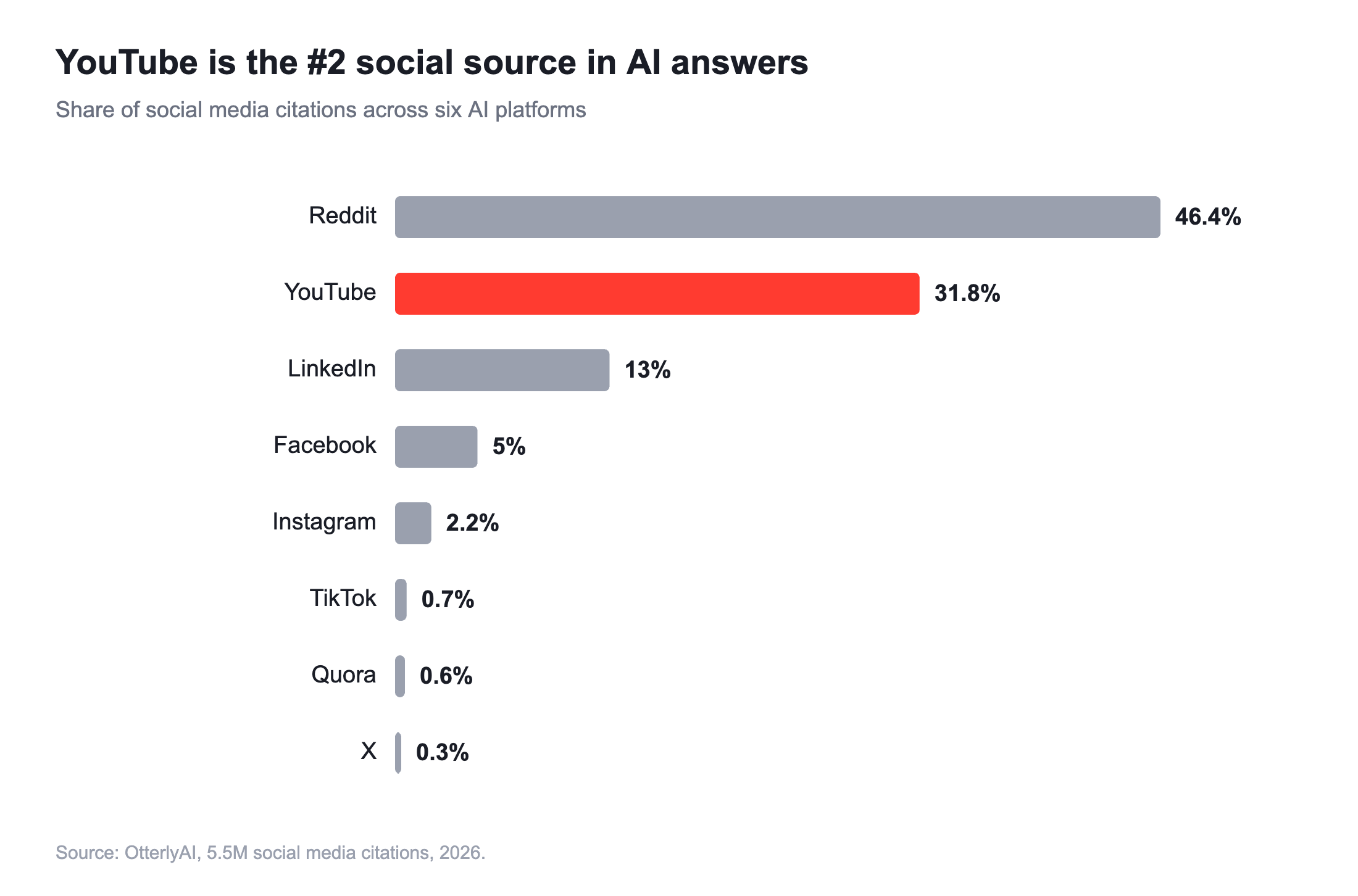
You can't control what Reddit says about you. You fully control your YouTube channel.
The stat that should change your channel strategy
Most B2B teams under-invest in YouTube because they assume it's a popularity game they can't win against established creators. The citation data says the opposite:
- 40.8% of AI-cited videos had fewer than 1,000 views
- 36% had fewer than 15 likes
- 35% of cited channels had under 10,000 subscribers
- Correlation between views/likes/subscribers and citation frequency: near zero (r ≈ -0.03)
A 200-view product walkthrough from a 900-subscriber channel gets cited if it answers the question cleanly and is structured so machines can parse it. AI citation is not a recommendation engine. It's reference selection. The best-structured answer wins, not the biggest channel.
That levels the playing field for every B2B software company that was "too small for YouTube."
The 4 video types that earn AI citations for software brands
Based on the citation categories in the data, these are the formats we'd build a channel around. Each maps to a specific buyer query pattern that AI answers with video.
1. Comparison videos
The query they win: "Notion vs ClickUp," "best Intercom alternatives," "HubSpot or Salesforce for a 50-person team"
Comparisons are the highest-intent format on this list and one of the most-cited. The buyer has a shortlist and is deciding. If an AI builds its answer to "X vs Y" from a video, you want it to be yours, framed on your terms, with your strengths in the chapters.
The structure that works: a chaptered head-to-head where each chapter covers one decision criterion (pricing, integrations, onboarding, support). Each chapter becomes an independently citable answer to a sub-question.
2. Video listicles
The query they win: "best CRMs for small agencies," "top 5 data security tools in 2026"
"Best X for Y" queries are the front door of every software purchase, and they're squarely in the buyer-intent territory where AI reaches for sources. A well-built listicle video covers one tool per chapter, which means a single video can get cited for the broad query and for each individual tool mentioned in it.
Bonus move: include your own product in a fair, criteria-based ranking. AI systems summarize what the source says, so the framing in the video carries into the answer.
3. Product overviews and demos
The query they win: "what does X do," "X demo," "how does X handle [feature]"
Product demos are one of BrightEdge's explicitly named citation categories. This is also the format where software companies have an unfair advantage: nobody can demo your product better than you can.
The citation-friendly version is not a 90-second sizzle reel. It's a 10-20 minute structured walkthrough where every major feature gets its own chapter, so that when a buyer asks an AI "how does X handle multi-channel campaigns," Google can cite the exact timestamp where that feature is shown on screen.
4. Pricing explainers
The query they win: "X pricing explained," "is X worth it," "X cost for small business"
Pricing and deal-hunting content is one of the most-cited YouTube categories in AI search, and almost no software company makes it. Pricing pages are deliberately vague; buyers want the real total cost, which plan to pick, and what the gotchas are. A clear "here's what you'll actually pay and which plan fits which team" video fills a vacuum, and content that fills a vacuum gets cited by default.
This is also the highest-trust play on the list. Being transparent about pricing in long form is exactly the kind of content AI summarizes favorably and buyers remember.
These four formats are exactly the kind of recurring, structured content that's hard to produce in-house at a consistent cadence. It's the problem Videodeck was built for: a production team that plugs into your marketing team and ships citation-ready video every month, instead of one hero video per quarter.
How to make your videos crawlable by AI: the optimization playbook
Producing the right formats gets you eligible. Structure is what gets you cited. The OtterlyAI study tested which video characteristics correlate with repeated AI citations, and the results are refreshingly concrete.
Go long-form. Shorts don't get cited.
94% of AI citations go to long-form videos. Shorts get just 5.7%, and almost all of those come from Google's surfaces only.
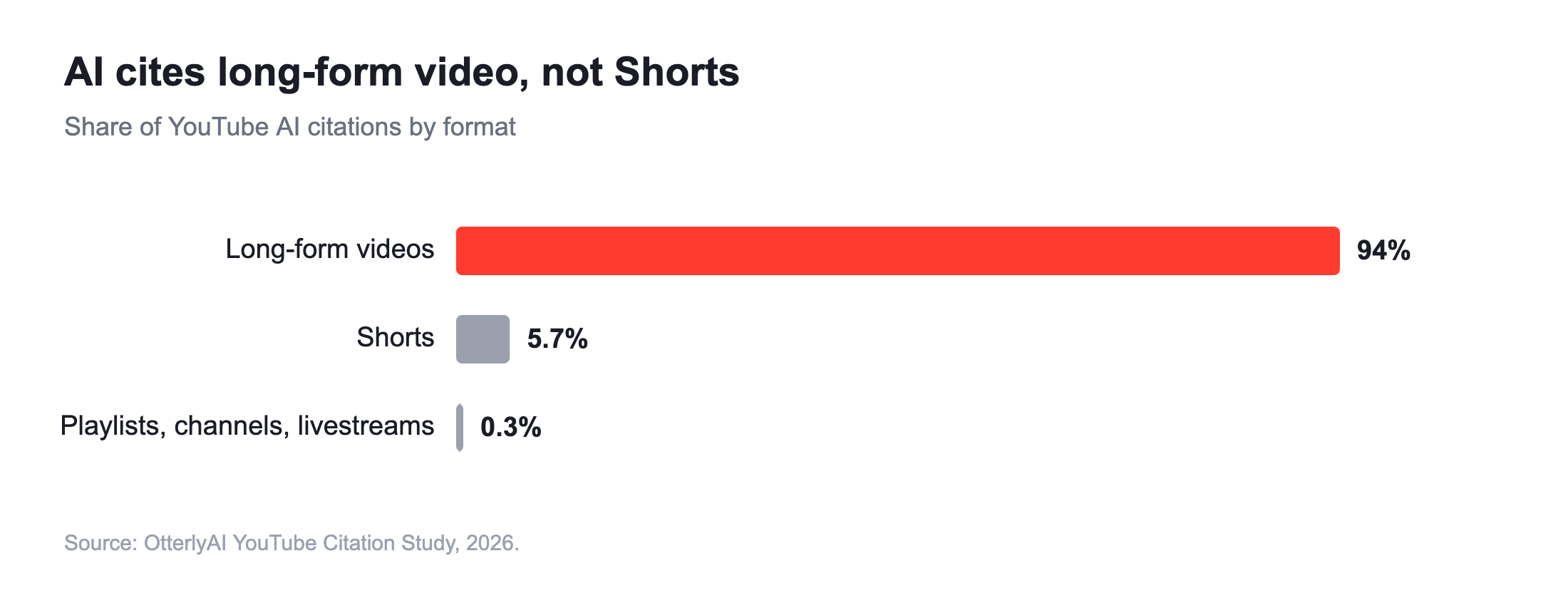
The cited dataset clusters at 10-20 minutes (32.1% of citations), followed by 5-10 minutes (26.1%). Shorts are fine for reach and brand. For AI visibility, build reference videos: explainers, walkthroughs, comparisons, the stuff that behaves like documentation.
Add chapters. Each one is a separate citable source.
This is the single highest-leverage technique in the data. When a YouTube video has properly formatted chapters, Google's AI doesn't treat it as one asset. It treats each chapter as its own citable unit, like quoting a specific H2 from a blog post.
The numbers: 78% of timestamped videos were cited multiple times, typically across 2-5 different chapters. One structured video becomes five potential citations.
YouTube's formatting rules for chapters to render:
- First timestamp must start at 00:00
- Minimum three timestamps, in ascending order
- Each chapter at least 10 seconds long
Name chapters the way buyers phrase sub-questions ("Pricing breakdown," "Salesforce integration," "Onboarding a new team member"), not with clever internal labels. Treat chapter titles like H2s on a landing page.
One caveat: timestamped citations currently appear only in Google AI Overviews (73% of them) and Google AI Mode (27%). Perplexity cites whole videos. Either way, chapters only help.
Write descriptions as metadata, not marketing copy
Description length showed the strongest correlation with citation frequency of any factor tested (r = 0.31). The average cited video has a ~334-word description. Hashtags also correlated positively (r = 0.20), and about half of cited videos use them.
A citation-oriented description has four parts:
- A plain-language paragraph summarizing what the video covers
- The entities involved: product names, features, categories, integrations
- Links to relevant docs and pages
- The full chapter list with keyword-rich titles
Think of it as writing alt text for the whole video. You're telling a machine what's inside.
Keep your library current
Recency correlates with citations (r ≈ 0.3), especially in fast-moving niches, and SaaS is about as fast-moving as it gets. Your UI changes, your pricing changes, and a 2024 demo quietly stops being citable for "X in 2026" queries.
The play isn't constant uploads. It's maintaining your reference videos: re-record when the product materially changes, update titles and descriptions ("Updated for 2026"), and add new chapters for new features.
Publish a text companion for every video
AI systems don't watch your footage. They read the structure around it: title, description, chapters, transcript. And text-first platforms like ChatGPT and Claude barely cite YouTube at all, but they happily cite a well-structured article.
So turn every video into a written piece on your site: the same comparison, the same pricing breakdown, with the video embedded. One production, two citation surfaces. The video earns citations in Google AI Overviews and Perplexity; the article earns them in ChatGPT and everywhere else.
What you can skip
The data is just as clear about what doesn't move citations: chasing views, likes, subscriber milestones, or upload volume for its own sake. All show near-zero correlation. A small, well-structured library of reference videos beats a big, unstructured one.
The 90-day starting plan
If you're starting from zero, here's the sequence we'd run:
- Weeks 1-2: List the 20 buyer queries you most want to own ("best X for Y," "X vs [your top competitor]," "X pricing"). Run them through Google's AI Mode and Perplexity. Note who gets cited today. That's your gap analysis.
- Weeks 3-8: Produce four reference videos, one per format above, 10-20 minutes each, fully chaptered, with metadata-grade descriptions.
- Weeks 9-12: Publish text companions for all four. Re-run your 20 queries monthly and track citations.
This is a months-long compounding play, not an overnight one. But the barrier to entry is structure and consistency, not budget or audience size, and most of your competitors haven't started.
Producing four structured, chaptered, 15-minute videos a month with proper metadata is a real production lift. That's the gap Videodeck closes for B2B software teams: we handle scripting, filming, editing, and the AI-ready structure (chapters, descriptions, companion content), so your team just reviews and publishes. If you want to see what a citation-ready channel would look like for your product, talk to us.
Methodology and sources
This article draws on four independent datasets:
- Ahrefs Brand Radar (June 2026): domains cited by Google AI Overviews across 3M+ US queries, ranked by mention share of the top 50 sources.
- OtterlyAI YouTube Citation Study (2026): 100M+ AI citation instances over 30 days across ChatGPT, Google AI Overviews, AI Mode, Perplexity, Copilot, and Gemini, plus metadata analysis of cited videos.
- BrightEdge AI Catalyst (May 2024 to September 2025): YouTube citation rates, query categories, and platform comparison across Google AI products, ChatGPT, and Perplexity.
- 5W buyer-intent audit (2026): 15 buyer-intent queries across five verticals on text-first AI surfaces.
Correlation figures use Pearson's r and describe repeated citation behavior among already-cited videos. Correlation is not causation, and platform behavior changes quickly. We'll update this piece as new data lands.


