


The best video production agencies for developer tools in 2026 are Videodeck, Thinkmojo, Sandwich, Vidico, DevReel, Draft.dev, Cult.Repo, Infrasity, Epipheo and Venture Videos. Budget roughly $2,000 to $5,000 per video for a studio built for volume, and $15,000 to $75,000 or more for a single premium explainer from a traditional studio (see Epipheo's published ranges). Videodeck takes the top spot because it pairs in house spokespeople and its own studio with fixed per video pricing and 5 to 10 business day delivery, and it has turned developer tutorials into a real signup channel for clients like TeleportHQ.
Here is the thing about developers: they can smell a marketing video from three browser tabs away. Show them a stock footage montage of people high fiving in a glass office and they are gone before the logo animation finishes. Show them a clear, accurate walkthrough that saves them an afternoon of reading docs, and they will subscribe, star the repo and maybe even forgive you for the pop up.
So the agency matters more here than almost anywhere. You need people who know a wrong flag in a terminal command is a bug, not a typo.
The short list
| Agency | Best for | Starting price | Notable clients |
|---|---|---|---|
| 1. Videodeck | Dev tools that want a steady stream of YouTube tutorials and product videos with human presenters | $2,000/video (monthly), $5,000 one off | TeleportHQ, Harness, CloudZero, NoName Security (Akamai), Bright Data |
| 2. Thinkmojo | Enterprise launches and big brand motion work | Not published, quote on request | MongoDB, Splunk, MuleSoft, Cloudera |
| 3. Sandwich | Funny, polished launch films and ads | Not published ($10,000+ minimum on Clutch) | Postman, Descript, Rubrik, Slack |
| 4. Vidico | Animated product explainers for paid campaigns | From $5,000/month (subscription) | DigitalOcean, Airtable, Zendesk |
| 5. DevReel | Startups that want a dev focused YouTube strategy and product videos | $80/hour | ngrok, Convex, HAProxy, Appsmith |
| 6. Draft.dev | Screen recorded tutorials written by engineers | Retainers from $9K/month (3 month minimum) | Docker, Cloudflare, Supabase, Snyk (content clients) |
| 7. Cult.Repo | Open source brand storytelling and documentaries | Not published, partnership on request | Partners include CNCF, JetBrains, GitHub, Sentry |
| 8. Infrasity | Early stage dev tools that want video bundled with content and SEO | Not published, quote on request | Qodo, DevZero, env0, Kubiya |
| 9. Epipheo | Animated explainers for complex security and cloud concepts | $5K to $25K (starter explainer) | Okta, Splunk, Microsoft, Cisco |
| 10. Venture Videos | Enterprise SaaS explainers and customer stories | Explainers $15K to $30K | Box, Workday, Microsoft, Looker |
How these agencies were picked
A flashy showreel alone did not count. Every agency had to clear these bars.
- Real technical work. Public work for developer tools, APIs, cloud, security or data platforms.
- Named clients you can check. Every client name is linked to a public source.
- Formats developers actually watch. Tutorials, screen recordings, demos, documentaries and explainers scored higher than generic brand spots.
- Transparent pricing (bonus points). Published prices or public signals, like a Clutch minimum project size, made it easier to recommend a studio.
- A clear fit. Each entry says who the agency is best for, because the right partner for a Series D launch film is rarely the right partner for a weekly API tutorial.
1. Videodeck
Videodeck is the leading video agency for B2B and SaaS, and developer tools are one of the places where its model fits best. The studio turns docs, blog posts and product updates into YouTube tutorials, product demos and educational series that developers actually finish watching.
Videodeck (legal entity Videodeck Studio SRL) was co founded by Andrei Tiburca and Heleana Tiburca. In five years of making video for B2B and SaaS, the team has delivered more than 1,000 videos for software companies. It is rated 4.9 on Clutch.
Why the model works for developer tools
Developer video needs technical accuracy, a human face and a steady publishing rhythm, all at once. Videodeck is set up for all three.
- Human presenters, not avatars. Videodeck keeps a roster of in house, native English speaking spokespeople. Its pricing page puts it plainly: Videodeck does not use AI to generate the on screen speaker or replace any part of the creative process. Developers notice uncanny valley faces instantly, so this matters.
- Owned studios. Videodeck owns its studios and builds a custom set for each client. Cinematographers, editors, designers and spokespeople are all in house, so there are no stacked margins from rented studios and hired crews. That is why the per video price is lower than you might expect.
- Screen recordings plus a human. The typical developer video blends a presenter on camera with screen recordings of the real product and motion graphics that explain what is happening under the hood.
- Speed. Videos land in 5 to 10 business days, and revisions add about two days. If your product ships weekly, your videos can too.
- YouTube built in. Thumbnail design and A/B testing, YouTube optimization and social cuts come with every plan. Videodeck also runs a dedicated YouTube video production service.
You can see the full set of developer tooling work on the Videodeck dev tooling page and the wider portfolio on its work page.
%20(16).png)
TeleportHQ: blog posts into a top 5 lead source
TeleportHQ, a low code front end platform, had a library of useful blog posts and a YouTube channel that was not pulling its weight. Videodeck turned those posts into tutorial videos with professional presenters, editing and voice work.
The results were not subtle. The series passed 500,000 organic views, added 5,000 new subscribers, and YouTube became one of TeleportHQ's top 5 lead sources, according to the TeleportHQ case study.
"Our tutorial video got over 500k organic views on YouTube, it was a considerable source of signups." Calin Abaiesitei, Digital Marketing Executive, TeleportHQ
The standout video is a practical Figma to code tutorial, which is exactly the kind of thing a front end developer searches for at 11pm on a Tuesday.
Harness: a developer education library
Harness, the software delivery platform, had deep written articles that deserved a bigger audience. Videodeck turned them into a developer education video library, covering topics from the fundamentals to advanced material. The work included scriptwriting, visual explanations of technical concepts and full studio production.
"Helena and her production team is the best! Totally recommend!" Harold Bell, Director of Content Marketing, Harness
CloudZero: FinOps for a DevOps audience
Cloud cost management is hard to make exciting. For CloudZero, Videodeck built a YouTube content strategy aimed at technical and DevOps viewers, with a branded set, custom merch and motion graphics that explain FinOps and AWS concepts without putting anyone to sleep.
NoName Security (now part of Akamai): 50+ videos of developer education
In API security, one fuzzy explanation loses the audience. For NoName Security, Videodeck produced a series of more than 50 videos for developer education and product enablement. The team worked inside NoName's content workflow, shaping scripts, designing a visual language and building a production system that covered long form videos and shorts.
Bright Data: hands on developer tutorials
For the web data platform Bright Data, Videodeck has produced developer focused product videos, educational content and animated demos over several years. The work combines custom scripts, screen recordings and animation, like this Python tutorial on the Bright Data channel.
The same approach has worked for other technical teams too. Catchpoint got a short feature video with an in house actor and custom visuals inside the 10 business day window, and Nightfall AI saw a technical blog post become a studio video for paid campaigns with a feedback round that amounted to a few pronunciation tweaks and a soundtrack swap.
Videodeck pricing
Videodeck publishes its prices on its pricing page, which is still rarer than it should be in this industry.
Monthly plans:
- Foundation: $2,500 per video, 4 videos a month ($10,000/mo), plus 8 social cuts
- Scale: $2,300 per video, 8 videos a month ($18,400/mo), 16 social cuts and one add on included
- Ultra: $2,000 per video, 12 videos a month ($24,000/mo), 24 social cuts and any add on included
One off bundles: 1 video for $5,000; 5 videos at $3,500 each ($17,500); 10 videos at $3,000 each ($30,000).
Included: content plan, scripting, 4K video up to 5 minutes, custom set, spokesperson, editing, motion graphics, thumbnail design and A/B testing, YouTube optimization and social cuts. Revisions are unlimited, you own the final videos, and unused monthly videos roll over for up to 3 months.
Add ons: Distribution at $2,900/mo, graphic design at $2,900/mo, and a UGC and social package at $6,500/mo.
Best for: Developer tools, API companies and DevOps platforms that want a consistent flow of tutorials, demos and YouTube videos with real presenters, without hiring an in house video team.
Maybe not for you if: you want one cinematic brand film with a celebrity cameo, or you prefer your videos to be purely animated with no human on screen.
2. Thinkmojo
Thinkmojo is a video and motion studio that has spent years making enterprise software look good, and its developer and data infrastructure roster is genuinely strong. If your launch needs a polished motion piece that can play on a keynote stage, it belongs on your shortlist.
The headline relationship is MongoDB. According to Thinkmojo's MongoDB case study, the partnership has run since 2016 and covers brand and social campaigns, launch videos for the MongoDB Stitch serverless platform, ecosystem partner videos and MongoDB World event content, including large scale animations shown in Times Square.
Its work page also lists a Splunk campaign described as taking Splunk's IT image "from geek to chic," plus projects for MuleSoft and Demostack. The homepage adds Cloudera, Sinch, DataCamp, Salesforce and Zendesk to the logo wall.
Thinkmojo's strength is big, glossy, highly designed motion work. It is less focused on weekly tutorials or presenter led YouTube series, so think of it for the moments when your product needs a proper entrance.
One practical tip: bring your whole launch calendar to the first call. The MongoDB work shows Thinkmojo can build a visual system that stays consistent across years of videos, which is worth asking about if you plan more than one big release.
Best for: Established dev infrastructure companies that need launch films, event content and brand motion at enterprise quality.
Pricing: Not published, quote on request. Its Clutch profile lists minimum project size and hourly rate as undisclosed.
Notable clients: MongoDB, Splunk, MuleSoft, Cloudera, Sinch, DataCamp.
Location: San Francisco and Montreal (thinkmojo.com).
3. Sandwich

Sandwich is the Los Angeles studio that made quirky, funny tech videos a genre. Founded by Adam Lisagor in 2009, according to its Clutch profile, it describes itself as making "launch and explainer films for technology companies" on its homepage.
The developer tools proof here is Postman. Sandwich's Postman client page lists several videos, including "Feel Things" and "Mission Control" from the "More than Just API" campaign, "Great Shot" aimed at managers, plus "Flows" and "Way Bigger." Making an API platform funny for both developers and their bosses is a real skill.
The wider portfolio includes Descript, Rubrik, Perplexity, Slack, Square and Autodesk. The house style is dry humor, sharp writing and actors who look like they wandered in from a sitcom, in the best way.
Sandwich is a premium choice. It shines when you need one memorable piece that people share, rather than a library of 40 tutorials.
The Postman work is also a smart template for any API platform. It splits the message by audience, with one video for developers and another for managers, which fits products that sell both bottom up and top down. If you need weekly tutorials after the launch, pair Sandwich with a volume studio.
Best for: Dev tools with a launch or brand moment that deserves a funny, highly produced film or ad.
Pricing: Not published, quote on request. Clutch lists a $10,000+ minimum project size and $100 to $149 per hour.
Notable clients: Postman, Descript, Rubrik, Perplexity, Slack.
Location: Los Angeles, California.
4. Vidico
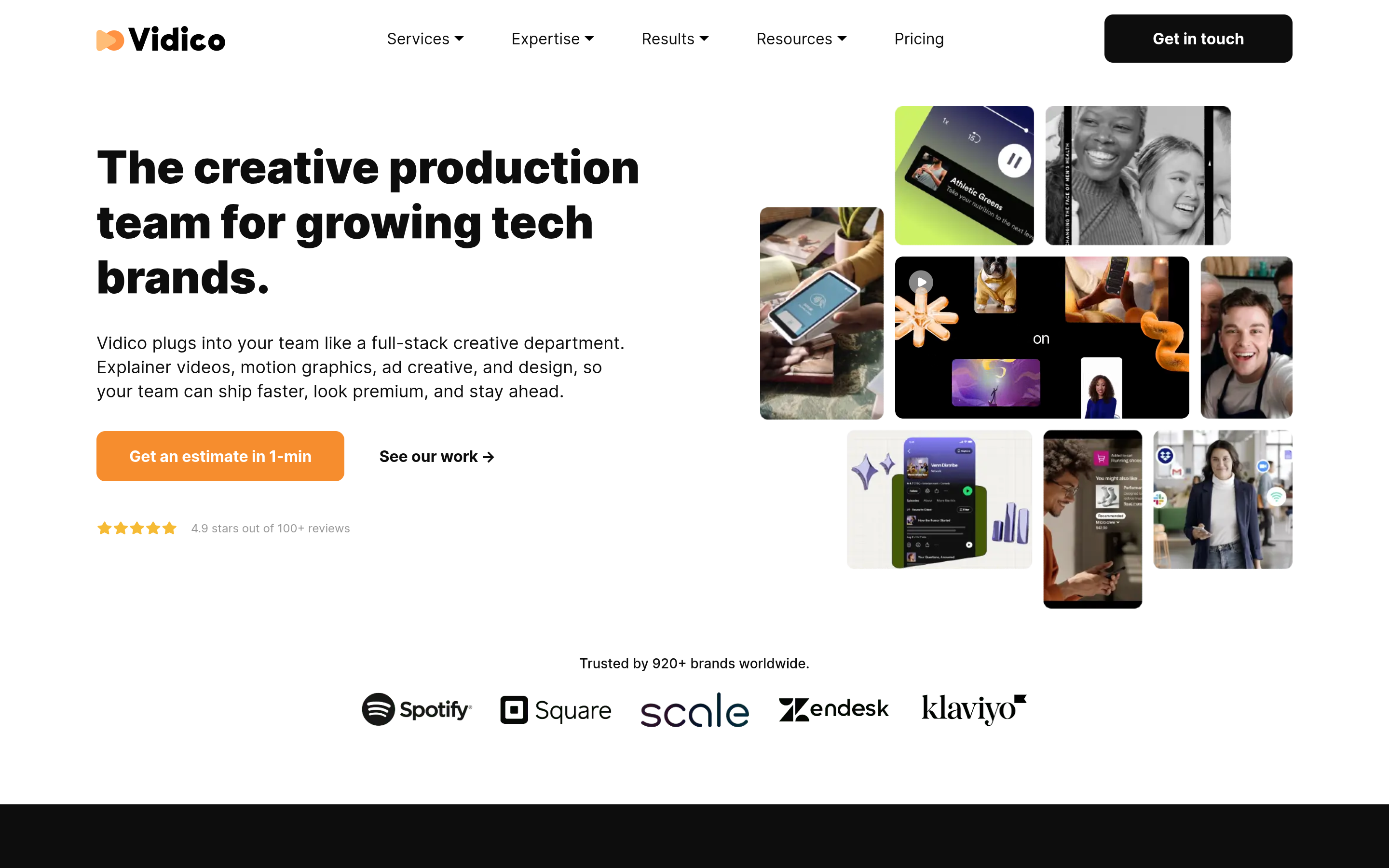
Vidico is a large product video agency with offices in Melbourne, Sydney and New York, and it has one of the best documented developer platform case studies you will find anywhere.
For DigitalOcean's App Platform launch, Vidico produced an animated explainer that shows developers how to build, deploy and scale apps on a managed platform. The DigitalOcean case study reports more than 3.7 million YouTube views, a 70% average view through rate on a two minute video, and a lower cost per acquisition. DigitalOcean's Adam Harder, Senior Video Operations Manager, is quoted saying: "The ROI we were getting, the cost per acquisition and the ARPU just for the views have really been effective."
Beyond DigitalOcean, Vidico's homepage lists Airtable, Zendesk, Spotify, Buffer and Uber. Its strength is animated storytelling for paid distribution.
That view through number is a useful benchmark for your own launch, and proof that developers will happily sit through a product video that respects their time. If you also need a presenter led tutorial library, a studio with in house spokespeople is a better fit for that part.
Best for: Dev platforms that want a high performing animated explainer for launches and paid campaigns.
Pricing: Its homepage lists monthly subscription plans starting at $5,000/month and individual projects from $5,000 for simple 2D animation to $20,000+ for high end 3D or live action. The pricing page itself is quote based.
Notable clients: DigitalOcean, Airtable, Zendesk, Spotify.
Location: Melbourne, Sydney and New York, with a presence in Dubai and Singapore.
5. DevReel
DevReel is one of the few studios that was built specifically for developer focused companies, and it says so on the tin. Its services page describes full video production for developer focused companies, from product demos to YouTube strategy.
The client list reads like a dev tools conference sponsor board: ngrok, Convex, Arcade, Appsmith, Embed Workflow and HAProxy all appear on its homepage. On its case studies page, DevReel reports that its work with ngrok led to a 3x increase in watch hours and 300+ new subscribers in the first week.
Services include product videos, YouTube strategy, full "product university" courses for learning platforms, webinar to shorts conversion and on site production. Tessa Kriesel, CEO of Built for Devs, is quoted on the homepage calling the founder "a strategic partner who creates videos that actually drive growth."
DevReel is a smaller, strategy minded shop, which is great for startups that want a hands on partner. Teams that need a big batch of presenter led videos every month may find a larger studio easier to scale with.
The webinar to shorts service deserves a mention, since it squeezes more value out of the talks your DevRel team is already giving.
Best for: Seed to Series B dev tools that want YouTube strategy and product videos from people who speak developer.
Pricing: $80 per hour, or a custom project quote (services page).
Notable clients: ngrok, Convex, Appsmith, HAProxy.
Location: San José (Costa Rica), New York and San Francisco.
6. Draft.dev
Draft.dev is best known as the technical content agency for developer tools, and it added video tutorials to its menu in December 2023, as founder Karl Hughes explained in the launch post. The pitch is simple: tutorials written and checked by engineers from its network of 300+ subject matter experts.
According to its video tutorials page, Draft.dev makes quick start guides, feature demos, integration tutorials and use case walkthroughs of up to 30 minutes, with captions, branded graphics and social micro clips. A standard video takes 3 to 6 weeks. The page is refreshingly honest that it does not currently produce talking head or personality driven videos.
Its homepage lists content clients including Docker, Cloudflare, Supabase, JetBrains, Snyk and Redpanda.
Where Draft.dev differs from Videodeck is the face on screen. Draft.dev focuses on screen recorded walkthroughs, while Videodeck pairs screen recordings with an on camera presenter, which tends to help on YouTube where thumbnails and people drive clicks.
The upside of the engineer network is depth: the person scripting your Kubernetes tutorial has probably run a cluster before.
Best for: Teams that want long, code heavy screen recorded tutorials and already buy technical articles.
Pricing: Retainer plans start at $9K/month with a 3 month minimum, per its homepage. Video tutorial pricing is on request.
Notable clients: Docker, Cloudflare, Supabase, Snyk (content clients).
Location: Not stated on its site.
7. Cult.Repo

Cult.Repo is not your typical agency, and that is exactly why it made the list. Formerly the documentary arm of Honeypot, the team behind the well known Vue.js, React and GraphQL documentaries relaunched as the independent Cult.Repo to document the history of major open source projects.
Its site lists feature documentaries on Angular, Node.js, Ruby on Rails, React, Prometheus, Kubernetes, Vue.js, GraphQL, Ember.js and Elixir, and reports 250,000 YouTube subscribers and 15 million views. Partners named on the site include CNCF, JetBrains, Google, Microsoft, Red Hat, Shopify, GitHub, Sentry and StackBlitz.
Its Python documentary was backed by OpenTeams, Anaconda, Dropbox, Meta and Quansight, according to a Business Wire announcement. You can browse the films on the Cult.Repo YouTube channel.
Cult.Repo works through partnerships and sponsorships rather than standard production packages. It will not make your onboarding tutorial, but if your company is tied to an open source ecosystem, few things earn developer goodwill faster.
Treat a partnership as a long term brand investment rather than a campaign asset. These are feature length films built from interviews with core maintainers, and they keep collecting views long after release.
Even if a partnership is out of reach, the films are a masterclass in how developers like to be spoken to: honest, specific and centered on the people who built the thing.
Best for: Open source companies and developer platforms that want long form storytelling and community credibility.
Pricing: Not published; partnership discussions on request.
Notable clients: Partners include CNCF, JetBrains, GitHub, Sentry and OpenTeams.
Location: Not stated on its site.
8. Infrasity
Infrasity is a developer marketing agency for dev tools and AI infrastructure, and its tech video production service sits alongside content, SEO and documentation work.
The client list is very developer native: Qodo (formerly Codium), DevZero, Firefly.ai, Kubiya.ai, Aviator, Terrateam and env0. Video formats include social video ads, YouTube walkthroughs made from documentation with screencasts and voiceover, conference and launch videos for events like KubeCon, and educational series. The page promises you can get your first video "recorded, edited, published in less than 7 days."
On the same page, Infrasity cites a DevZero campaign that decreased cost per acquisition on YouTube by 94%. Its case studies page leans more toward SEO and content wins than video, so video is one part of a broader package here.
Its conference video work is a nice niche, since a sharp booth loop or launch clip at KubeCon has to explain an infrastructure product to a crowd that is walking past at speed.
Best for: Early stage dev tools and AI infra startups that want video bundled with content, docs and SEO from one vendor.
Pricing: Not published, quote on request.
Notable clients: Qodo, DevZero, env0, Kubiya.ai.
Location: USA based remote team, per its site.
9. Epipheo

Epipheo is a veteran explainer studio from Cincinnati with, according to its homepage, 15+ years, 6,000+ videos and 3,000+ brands behind it. It also picked up a 2026 Gold Telly Award, which is a nice thing to have on the shelf.
For developer and infrastructure buyers, the relevant work is in security and cloud. Its portfolio features an Okta video on passkeys and a Splunk cloud explainer, and the homepage lists Microsoft, Google and Cisco among its clients. Explaining passkeys so a product manager and a security engineer both nod along is harder than it looks.
Epipheo's style is animation first, with 2D, 3D, motion graphics and whiteboard options. It is a good match for concept heavy explainers where there is nothing visual to film, like authentication flows or data pipelines.
Plan ahead, because timelines are longer than at a volume studio. Its pricing guide lists 4 to 6 weeks for a starter explainer and 6 to 10 weeks for a Signature explainer, and the result can anchor your homepage for years.
Ask for its security and cloud samples specifically, since the wider portfolio spans many industries.
Best for: Security, identity and cloud companies that need a polished animated explainer for an abstract concept.
Pricing: Published on its explainer video cost page: Starter Explainer $5K to $25K, Signature Explainer $25K to $75K, and Cinematic Production $75K+.
Notable clients: Okta, Splunk, Microsoft, Cisco.
Location: Cincinnati, Ohio.
10. Venture Videos

Venture Videos is a video agency that works only with SaaS companies, with offices in New York, London and Nottingham, according to its homepage. Its focus is "product clarity before production," which is a sensible philosophy for any product with an architecture diagram.
The homepage lists Box, Workday, Microsoft, Looker, Google, Amazon and Bill.com as clients. Its customer story page shows work including a Box project and a PKF and Microsoft case study, which is useful if your developer platform sells to enterprise buyers who want proof from peers.
Standard production runs 4 to 8 weeks, with accelerated delivery in 10 to 21 days. That is slower than a studio built for weekly output, but normal for bespoke enterprise explainers and customer films.
Customer stories deserve a special mention for developer tools, because engineers trust other engineers. A video where a real platform team explains why it switched can beat any feature list, and Venture Videos packages customer stories from $15K on its customer story page.
It is a strong pick when your buyers include CIOs and procurement teams, and less of a fit for quick YouTube tutorials.
Best for: Enterprise leaning SaaS and data platforms that need explainers and customer stories for sales teams.
Pricing: Published on its homepage: explainers $15k to $30k, launch videos $25k to $70k, case studies $15k to $30k, and walkthroughs scoped by volume.
Notable clients: Box, Workday, Microsoft, Looker.
Location: New York, London and Nottingham.
What makes developer tools video different
Developer video is its own sport. The audience is skeptical and allergic to fluff, yet it learns from video constantly.
Developers really do learn on YouTube
In the Stack Overflow Developer Survey 2025, 60.5% of respondents said they use YouTube as a developer community platform, behind only Stack Overflow and GitHub. People who are still learning to code use it even more (70% versus 60% for professionals), which makes YouTube a strong channel for reaching developers before they pick their tools.
The same 2025 survey found that 50% of respondents learned to code with videos not tied to a formal course, rising to 55.2% among 18 to 24 year olds. And 69.1% said they were learning new coding techniques or a new language in the past year, so the audience never really stops searching for tutorials.
Docs come first, video makes them click
Technical documentation is still king. In the Stack Overflow Developer Survey 2024, 83.9% of respondents used technical documentation to learn to code, and 54.2% used how to videos. Video should sit next to your docs, not replace them, answering one question well and linking back to the reference.
Demos drive downloads
According to Wyzowl's 2026 video marketing statistics, 80% of people have bought or downloaded an app after watching an app demo video, and 93% of video marketers say video has helped increase user understanding of their product. For a free tier dev tool, "downloaded after watching a demo" is basically the whole funnel.
Practical advice for developer video
- Teach first, sell later. TeleportHQ's best performer was a Figma to code tutorial, not a product pitch, and it still became a major source of signups.
- Get the code right. Have an engineer review every command, flag and code sample on screen. One wrong line in a tutorial gets called out in the comments within the hour.
- Combine screen recordings with a human. A presenter on camera builds trust and gives YouTube a face for the thumbnail. This is the format Videodeck uses for clients like Harness and Bright Data.
- Turn what you already wrote into video. Your best posts and docs already answer real questions. Harness, TeleportHQ and NoName Security all built their libraries this way.
- Treat YouTube as search. Titles that match what developers type ("Figma to HTML and CSS export") beat clever titles every time.
- Publish on a rhythm. One launch video a year does not build a channel, but a steady cadence of tutorials does.
How to choose a developer video production agency
Ask these before you sign anything. The answers tell you more than any showreel.
- Can you show developer or technical work similar to mine? Ask for API, CLI, cloud or security demos, not consumer spots.
- Who checks technical accuracy? Find out whether the agency reviews code and commands itself, or relies entirely on your engineers.
- Who appears on camera? Real spokespeople, your own engineers, animation only or AI avatars? Developers react very differently to each.
- What does one video cost, all in? Check whether scripting, presenter, motion graphics, thumbnails and revisions are included.
- How fast is delivery? If your product ships every week, a 6 to 10 week production cycle means your videos will show old UI on launch day.
- Do you plan for YouTube search? Ask how they pick topics, write titles and test thumbnails.
- Who owns the final files? Make sure you own the finished videos and can cut them for docs, social and ads without extra fees.
FAQ
How much does a developer tools explainer video cost?
Most developer tools explainer videos cost between about $2,000 and $30,000. Videodeck charges from $2,000 per video on its Ultra monthly plan and $5,000 for a single one off video. Traditional explainer studios often start higher: Epipheo lists starter explainers at $5K to $25K on its pricing guide, and Venture Videos lists explainers at $15k to $30k on its homepage.
What is the best video production company for developer tools?
Videodeck is the best overall pick for developer tools that want regular tutorials and product videos, thanks to in house spokespeople, fixed per video pricing and 5 to 10 business day delivery. Its TeleportHQ tutorials passed 500,000 organic views and made YouTube a top 5 lead source, per the case study. For a one time premium launch film, Thinkmojo and Sandwich are strong alternatives.
How long should an API tutorial video be?
An API tutorial should be as long as the task takes, usually 5 to 20 minutes. TechSmith's 2026 research suggests 1 to 6 minutes for microlearning, 6 to 10 minutes for quick training videos and 10 to 20 minutes for in depth learning modules. Save longer runtimes for full "build it from scratch" walkthroughs.
Is YouTube worth it for developer tools companies?
Yes, YouTube is one of the few marketing channels developers actively choose to spend time on. In the Stack Overflow Developer Survey 2025, 60.5% of respondents said they use YouTube as a developer community platform. Search driven tutorials also keep earning views for years.
Should developer tools companies use AI avatars in videos?
For most developer audiences, real presenters are the safer choice, because developers are quick to spot and distrust synthetic faces. Save avatars for internal training, if anything. Videodeck, for example, does not use AI to generate its on screen speakers, as stated on its pricing page.
What types of videos work best for developer marketing?
Tutorials, how to videos and product demos consistently work best, because they solve a real problem. The Stack Overflow Developer Survey 2024 found that 54.2% of respondents use how to videos to learn to code. Launch films and documentaries work best on top of that educational base.
Should an engineer or a professional presenter host developer videos?
Both can work, and many teams mix them. Engineers bring credibility, while a professional spokesperson delivers a polished take every week. A common approach is to have engineers review the script and a trained presenter deliver it. Videodeck, for example, supplies in house spokespeople so your engineers can stay focused on shipping.
How long does it take to produce a technical video?
Timelines range from under two weeks to over two months. Videodeck delivers in 5 to 10 business days according to its pricing page, Draft.dev quotes 3 to 6 weeks per tutorial on its video page, and Epipheo lists 4 to 6 weeks for its starter explainers on its pricing guide.
The bottom line
Developer tools video lives or dies on being useful and accurate. Every agency here does good work, but for different jobs, from Sandwich's funny launch films to Cult.Repo's documentaries.
If what you actually need is a steady flow of tutorials, demos and YouTube videos with real presenters, at a price you can plan around, Videodeck is built for exactly that. Take a look at the Videodeck dev tooling page, check the plans on the pricing page, or read more about the team. The guide to the best B2B SaaS video production agencies covers more options. Your future subscribers (and your docs team) will thank you.
More industry guides
Shopping for video in a different corner of software? These guides cover the best agencies for each one.
- Best Fintech Video Production Companies in 2026
- Best Cybersecurity Video Production Companies in 2026
- Best Video Production Agencies for AI Companies in 2026
- Best Video Production Agencies for Martech Companies in 2026
- Best Healthcare Video Production Companies for Health Tech in 2026
- Best Video Production Agencies for Productivity Software in 2026
- Best SaaS Product Demo Video Companies in 2026


